Kentucky Clay Court - Croquet Rules
by Paul Bennett (from my notes dated 2 July 1994)
and
now written down 13 June 2004
and revised 4 Mar 2010
In Kentucky, clay court Nine Wicket rules were last revised in 1936
by the State Parks and Recreation Department to codify the rules for
their state championships. The game was faithfully played in the
Kentucky for 80 years on a weekly basis by several clubs and more
frequently by several ardent players. For years the game was
supported with modest funds by its players, its clubs and through the
support of the Kentucky State Parks. Both singles and doubles
state championship events were held annually.
[If someone has a copy of the title holders for these events, please
send me a copy and I will gladly upload them to this website.]
My grandpa was a carpenter by trade but he played the game of croquet
as a pastime and made mallets when the weather drove him inside.
In the 50s, there were many more clay croquet courts to be found and he
frequented the court at Tyler park. When I began playing in the
90s, I was introduced to the clay court game by a gentlemen named
Bernie down at the last court in Louisville, KY at Wyndotte
Park, off Taylor Blvd and I65. This court was housed inside a
large aluminum shed alongside a second court just outside the
building. Since 2008, the building was closed due to structural
concerns by the parks and recreation. My brother and his friend
are working with the Kentucky historical society to once again get
access to this facility.
In addition to one in Louisville, I played at three other venues
One was located in Frankfurt, KY near the state capitol, a second
one at Jamestown
near
the Land between the Lakes, and a third was at a private farmer's
house; his name was Archie Burchfield.
Bernie, the secretary/treasurer of the Wyndotte croquet club, passed
around the turn of the millenium.
Archie Burchfield passed February 16, 2005 - a key player of both the
Kentucky
Clay court rules and the USCA Six Wicket game.
In 2008, Buck Wilhoite passed, the Commissioner of the Kentucky Clay
court game.
The official set of rules are not reprinted here, as I seem to have
misplaced
them somewhere in my office (or if someone has borrowed them, please
return them).
Here is a summary of the rules as I know them.
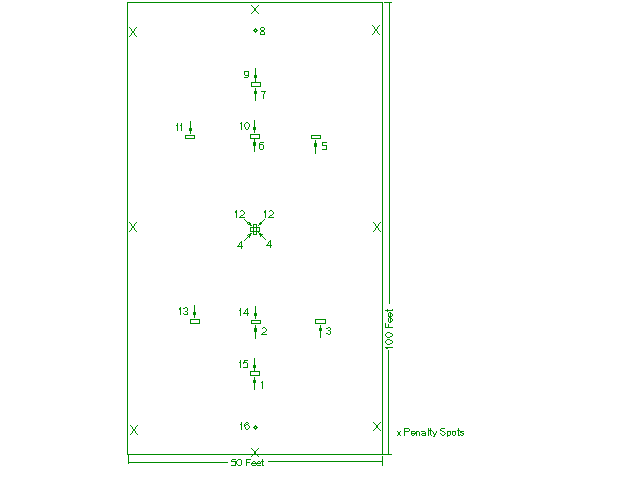
KY Nine Wicket Layout
Court and Equipment Characteristics:
Smooth Clay court - very fast speed.
Wickets set in Concrete and buried under the clay.
Steel wire is used to mark the court boundary.
Wickets only slightly taller than the ball - i.e. the hoop cannot be
run by a jumphot
over
a blocking ball.
Balls are smooth in texture, solid and similar in weight to a Jacques
Eclipse
ball.
Notice the layout with hoop 3 level with hoop 2. Start about 6'
back
from hoop 1.
The mallets are custom made. The mallet face consists of two
playing
surfaces, one hard surface called fiber and one soft surface made of
rubber.
The handles are generally short, though many new mallets are being made
using
longer
handles to allow a more upright stance. (This was changed with
the influence from six-wicket players like Archie Burchfield.)
Clips and deadness boards (or a clipboard with a deadness sheet) are
used
only during tournaments.
Players are generally expected to remember deadness and hoop positions
but this is sometimes problematic and a starting point of
contentiousness.
Clocks are generally not used, unless players are waiting to play.
During
tournaments, a 3-5 hour time limit is set for a best of three match,
whereas during local weekend club play, clocks are used to set a 1 hour
time limit and play is stopped when the clock expires, hoops are
counted and the winner is determined by most hoops advanced.
- The colors of the balls are Red, White, Blue and Black and the
players
follow this order of play. Red is teamed up with Blue and White
is
teamed up with Black. It is usual to play a game of doubles but
if singles is played then all four balls are used. (There is a
game of three called poison but it is not commonly played.)
- The order of the hoops follow the diagram of the court. The
hoops
are numbers from 1 to 16 each hoop counting for 1 point. The peg
in
the middle is number 8. Players refer to the hoops by these
numbers
(there is no 1-back, 2-back designations).
- The hoops must be run in the order shown, note that you may
go
thru the basket (middle hoop) in either of two directions shown.
The
hoop must be run in a straight direction, i.e. you may not start by
running
the hoop in the NE direction and then half way through decide to exit
through
the NW direction.
- When you hit a ball, referred to as a bump or a roquet, you are
entitled
to two strokes; the first is the croquet stroke and the 2nd is
the
continuation stroke.
- During the croquet stroke, you place your striker ball in contact
with
the ball you hit where that ball came to rest at the end of the roquet
shot. You may a) hold your ball with your hand and drive
the
other ball away. (This is referred to as a tight.) Or you may
b) strike
your ball into the other ball causing both balls to move. During
this shot called the
croquet shot, the croqueted ball must at least 'shake'; you may not
shoot
away from the croqueted ball without causing it to move.
- During either the roquet or the croquet shot, you may score the
roqueted ball through its hoop or against the peg at position 8.
The striker does not earn any additional shots in scoring a point for
either its partner or its opponents ball unless the striker's ball
scores one of its hoops in proper order.
- You become dead on the ball you've hit and taken croquet from and
may not hit that ball
again
until you go through your next hoop. In subsequent turns, you
remain
dead on the balls you've hit until you go through your next hoop (see
rule 7 for rover ball).
- If you hit two balls in the same stroke, you take croquet and
deadness from the first ball hit. The second (and third ball if
struck) goes back to its original resting spot prior to the stroke.
- When your ball has gone through all the hoops (1-15), you become
a rover ball. A rover ball is alive on all balls
at
the beginning of each turn and the rover ball may hit any ball in any
order once during its turn.
- A ball crosses out of bounds when the center of the ball is
beyond
the boundary line. The boundary line is either marked with a
string
or a metal wire. In general this line should not impede or
prevent
a ball from crossing the boundary.
- If a ball is not out of bounds, it remain where it lays, which
might
be right next to the string. When placing your ball in contact
after
a bump for a croquet shot, you may not place your ball out of bounds.
Notice that this may limit your possible options.
- If you knock your ball or your partners ball out of bounds, your
ball(s)
become placed on the nearest 'penalty spot' in the zone your ball went
out
of bounds. If the spot is already occupied with another ball,
your
ball is placed on the opposite spot. In zone I for example, if
you
go out of bounds on the south boundary, then place your ball on the
spot
south of stake 16. If you go out of bounds on the east boundary,
then
place your ball on the east boundary spot, unless occupied, then place
your
ball on the west boundary zone I spot. See rule 14 for
explanation
of zones I, II and III.
- If you knock your opponents ball out of bounds, the opponent may
place
his ball on the boundary line where the ball went out of bounds or on
the
spot.
- There are three zones. Zone I is south of hoops 3 and 13.
Zone
II is south of hoops 5 and 11 and north of zone I. Zone III is
north
of hoops 5 and 11. When you are on a 'penalty spot', you may not roquet
a
ball in that zone.
- All other balls that are hit after a roquet, either by the
striker
ball
or by the bumped ball, are replaced. If a ball occupied a spot
that
the bumped ball now occupies, the bumped ball comes back in contact
with
the
ball occupying that spot at the spot the ball contacted the moved ball.
- Striker faults bring all the balls back to where they started
prior
to the stroke. Faults include hitting a ball you are dead on;
causing
damage to the court by striking the court with your mallet during the
follow
through or prior to hitting the striker ball; hitting a ball other than
the
striker ball; letting go of your ball when holding it during a croquet
shot.
- The strikers ball can go out of bounds after hitting a ball it is
alive
on. The roqueted ball may not go out of bounds or the turn ends
(and
rule 11 applies). Some local customs discourage sending an
opponent's
ball out of bounds if it gives an apparent advantage to the striker.
Some
have suggested calling deadness on the striker; others have suggested
allowing
the opponent to bring the balls back to the positions prior to the
stroke
in question. The official rules have not been modified and no
penalty
is prescribed in the official rule book.
- There is no relief from deadness except to score the hoop.
Often
times it is best to 'take shape', i.e. setup in front of your hoop.
- There are no wiring rules. You may move your opponent's
balls
in the most unfavorable position each turn preventing them from scoring
their
hoops or hitting a ball they may be alive on.
- The basket, hoop 4 and 12, is the most difficult hoop to run.
Often
players will avoid becoming dead on balls prior to attempting to score
the
basket. Located in the middle,this hoop is central to the
strategy
of play in the game.
- When scoring a hoop, the striker ball must pass clearly through
the
hoop and beyond the plane of the playing side of the hoop without
hitting
a ball it is dead upon. If after clearing the hoop, the ball
contacts
a ball, then the striker is ball in hand and immediately takes croquet
from
that ball.
- If a player scores a hoop and in the same turn goes out of bounds
or
causes another ball to go out of bounds, the hoop is scored, the turn
ends
and rules 10 or 11 apply.
- A play must be made prior to or on the 3rd full rotation since
the
last play. A play is made by hitting a ball the striker is alive
on
or by scoring a hoop. If a team fails to make a play on the 3rd
rotation,
the opponent may call deadness on one of the balls the striking team is
alive
on.
- The blocking rule is a difficult rule to understand but necessary
to prevent players from completely preventing play from
proceeding. Your
opponent
must acknowledge when you claim a first block. A block is when a
ball you are dead on
prevents
you from scoring your wicket or from hitting a ball you are still alive
on. If a player blocks you a second time with either of his
teams two balls, you may
call
a second block. Then the opponent has to replay his shot in a
different
direction so as not to block. The second block does not have to
occur on two consecutive
turns.
I have been told that if you ask for the opponent to move, then you
must take the shot at the hoop or the ball from which you have
claimed a block.
- The game ends when both partner balls have scored the 15th wicket
and
the striker drives both the partner and the striker ball into stake 16
in
one shot or the partner ball into stake 16 in the croquet shot and then
the
striker ball into the stake on the continuation stroke. If the
striker
fails to peg both balls out in this manner, the games continues and
neither
ball is removed from the game.
- Games are usually not timed, but if players are waiting for court
time,
then a 1 hour timer is started. When the clock expires, the game
is
over and the team with the most points scored at the buzzer is the
winner.
No additional shots may be played after time is called.